
Cantonese Voice Acting Industry Trends Shaping Global Media
The landscape of Cantonese voice acting is shifting as international entertainment markets expand and digital distribution platforms reshape audience expectations. Streaming services, animated productions, online games, and educational media have all increased the need for authentic vocal performances in different languages. Within this evolving environment, Cantonese voices remain highly valued for their cultural expression and tonal depth. These performances help audiences connect emotionally with characters and narratives that originate from different regions and storytelling traditions.
The global circulation of films, games, and television programmes has changed how producers approach localisation. Rather than relying solely on subtitles, many studios now invest in high quality voice performances that recreate the emotion and rhythm of the original script. Cantonese speaking communities across Hong Kong, mainland China, and international diaspora markets represent an audience that appreciates culturally accurate voice acting.
As demand grows, production teams and studios often look to book Cantonese voice actor talent who can deliver authentic dialogue and culturally resonant performances for global audiences.
Understanding Cantonese voice acting industry trends allows actors, production teams, and entertainment professionals to recognise where opportunities are developing. Changes in the film industry, the rise of digital content distribution, and new expectations around cultural authenticity are influencing how voice performances are created and recorded. At the same time, performers who combine linguistic skill with acting ability are increasingly involved in international projects that require both creativity and technical recording expertise.
The growth of these projects signals a continuing shift toward multilingual storytelling within the global entertainment environment.
Streaming Platforms and Chinese Film Industry Expansion Driving Voice Acting Demand
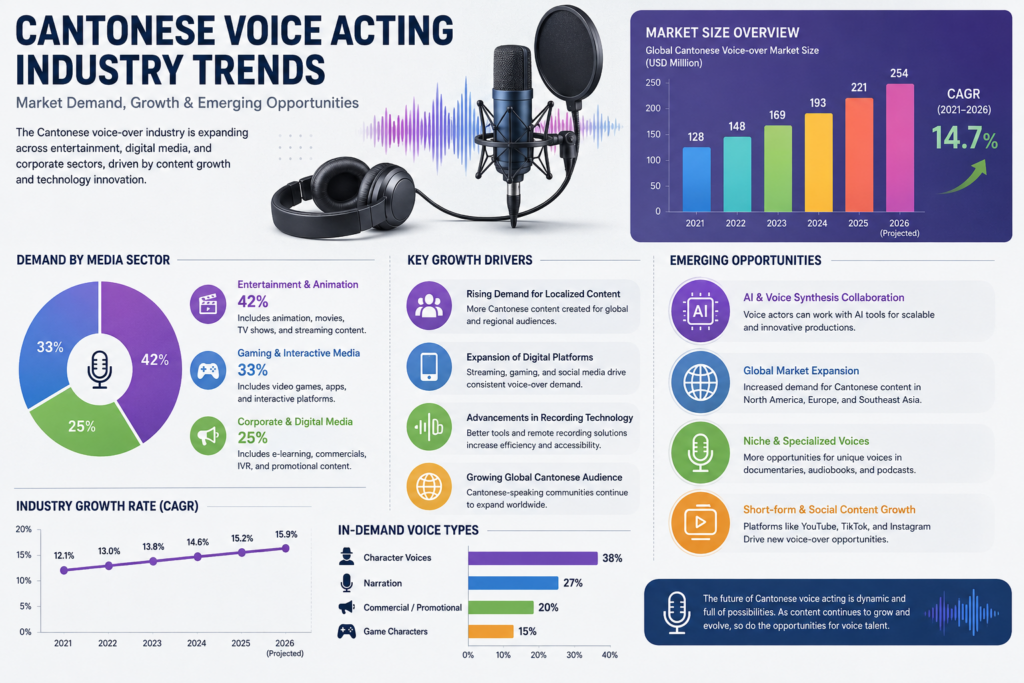
Streaming platforms have altered the way viewers consume media, allowing audiences to access films, series, and documentaries produced across different countries. This transformation has expanded the need for Cantonese voice performances that support localisation and distribution across various markets. When global productions are released simultaneously in multiple regions, voice acting becomes a practical way to ensure viewers can follow dialogue naturally while still experiencing the intended emotion of a scene.
The Chinese film sector has also contributed to this development. Over recent decades, the film industry has expanded both domestically and internationally, creating a large volume of projects requiring multilingual adaptation. Films produced in Mandarin, Korean, Japanese, or English are frequently adapted into Cantonese to reach audiences in Hong Kong and other communities where the dialect remains widely spoken. This demand encourages studios to collaborate with trained voice-over artists who can recreate performances while respecting regional speech patterns.
Another reason for rising demand relates to the expectations of modern audiences. Viewers now recognise the difference between generic translation and carefully directed voice performances. Skilled actors can match the pacing and emotional intensity of the original performance, which helps maintain storytelling continuity. Producers therefore treat voice dubbing as an artistic process rather than a purely technical translation step.
The expansion of international streaming platforms has also created new distribution channels for animated series and documentary programmes. These projects frequently require voice artists capable of recording in professional studios or remote setups. Advances in audio recording technology have made it possible for performers to contribute from different countries while maintaining broadcast quality. This flexibility allows casting directors to collaborate with Cantonese speaking actors across the world.
Opportunities for Chinese Cantonese Voice Talent Across Animation Gaming and Global Media
| Media Sector | Type of Voice Work | Purpose of Cantonese Voice Talent |
|---|---|---|
| Animation and Animated Films | Character voice acting and dubbing | Deliver emotion and personality for animated characters |
| Video Games and Interactive Media | Dialogue recording and narrative voice work | Support immersive storytelling for players |
| Corporate and Digital Media | Narration and promotional voice recordings | Communicate messages clearly for Cantonese-speaking audiences |
Animated films rely heavily on expressive vocal delivery because characters often communicate personality and emotion through sound rather than physical gestures alone. A well delivered vocal performance can influence how audiences interpret humour, tension, and dramatic moments within animated narratives. Game developers have also increased their use of Cantonese voice recordings.
Modern video games often contain extensive dialogue sequences and narrative cut scenes that guide players through complex stories. When these games are released in different regions, localisation teams adapt both text and spoken dialogue so that players experience the storyline naturally. Cantonese voices therefore become part of the immersive design that helps players engage with the fictional environment.
Beyond animation and gaming, Cantonese voice recordings are also used in corporate media, advertising campaigns, educational platforms, and digital marketing. Companies that operate internationally frequently produce training videos or promotional materials in several languages to communicate effectively with regional audiences. Cantonese speaking presenters and voice actors assist these projects by delivering clear and culturally appropriate narration.
Podcasting and online video production have introduced another avenue for voice performers. Content creators who target Cantonese speaking listeners often rely on professional narration for storytelling series, interviews, and educational programmes. These formats highlight the flexibility of voice acting because performers may shift between character roles, narration, and conversational dialogue depending on the project’s format.
Cultural Authenticity and Communication Skills Defining Successful Voice Performances
Authenticity remains an important element of Cantonese voice acting. The dialect contains distinct tonal structures that influence how words convey meaning and emotional context. Actors therefore require strong linguistic awareness to maintain accuracy while still delivering a believable performance. Even small variations in tone can change the meaning of a phrase, which means voice actors must balance technical precision with expressive acting ability.
Cultural familiarity also shapes the success of a performance. Many scripts contain references to local customs, humour, or everyday expressions that cannot simply be translated word for word. Instead, actors and directors collaborate to interpret the intent behind a line and adapt the delivery so it resonates with Cantonese speaking audiences. This process often involves careful communication between translators, writers, and performers during the recording stage.
Training programmes for voice actors typically focus on vocal control, character development, and microphone technique. Actors learn how to adjust breathing, pitch, and pacing so their voices remain clear during long recording sessions. These skills help performers maintain consistent sound quality across different scenes while avoiding vocal fatigue.
Another factor that contributes to strong performances is the ability to interpret scripts quickly. Recording sessions often involve multiple takes as directors refine the emotional tone of each line. Actors who can respond to direction and adjust their performance efficiently become valuable members of the production team. This flexibility helps maintain a smooth workflow during dubbing sessions where timing and coordination are essential.
Casting Practices and Production Methods Shaping the Cantonese Voice Over Industry
Production studios and casting agencies continue to refine their approach to selecting voice actors for Cantonese projects. In earlier decades, casting decisions often focused mainly on vocal tone. Contemporary productions require a wider assessment that includes acting range, linguistic precision, emotional interpretation, and familiarity with recording environments. Audition sessions now allow actors to demonstrate how they shape character personalities, interpret dialogue pacing, and respond to creative direction during recording.
Voice casting is also closely linked to narrative design. Producers seek performers whose delivery matches the emotional tone and pacing of the story being produced. In animation and series production, voice actors sometimes collaborate with animation teams to ensure spoken lines correspond naturally with character movement and visual expressions. This coordination strengthens the connection between visual storytelling and spoken dialogue, helping audiences experience a cohesive performance.
Modern recording environments rely on specialised audio systems that capture detailed vocal textures. Sound engineers supervise recording sessions by controlling microphone sensitivity, acoustic conditions, and audio balance. After recording, editors refine dialogue tracks so they blend smoothly with music, ambient sound, and other character voices. These technical processes contribute to the polished sound quality required for film, television, and digital media projects.
International collaboration has also become common within Cantonese voice productions. Creative teams may include translators, directors, actors, and engineers working across several regions. Digital communication platforms enable these teams to exchange recordings, provide performance feedback, and coordinate production schedules. This workflow allows projects to combine creative contributions from multiple locations while maintaining consistent audio quality.
• Casting directors often analyse audience demographics to ensure selected voices resonate with the intended regional listeners.
• Script adaptation specialists sometimes adjust dialogue timing and phrasing before recording sessions begin.
• Post-production teams frequently layer multiple vocal tracks to create richer sound depth for complex scenes.
• Production managers coordinate recording schedules to align voice sessions with animation or editing timelines.
Training Pathways and Career Development for Emerging Cantonese Voice Actors
Entering the Cantonese voice acting profession often begins with acting training or previous performance experience. Many voice performers develop their abilities through theatre, television, or film before focusing on vocal roles. These experiences build skills in character interpretation, emotional delivery, and script understanding that transfer effectively to voice work.
Voice training programmes also teach practical studio techniques. Actors practise breathing control, articulation, and microphone awareness so their voices remain consistent and clear throughout recording sessions. These technical abilities help performers maintain vocal stability during extended dialogue recording while ensuring sound quality remains professional.
Creating a professional portfolio helps emerging actors present their vocal range to producers and casting directors. Demo recordings usually feature several short performances that demonstrate narration, character dialogue, and expressive delivery styles. These recordings allow production teams to evaluate how an actor’s voice might suit different storytelling formats.
Professional connections also influence career development within the entertainment sector. Voice actors frequently collaborate with directors, producers, and fellow performers who may recommend them for future projects. Workshops, creative seminars, and industry gatherings offer opportunities to learn new recording practices while building relationships with professionals involved in dubbing and audio production.
As digital media production continues to expand, many voice actors also develop personal recording setups. A small home studio equipped with a professional microphone, acoustic treatment, and editing software allows performers to audition and submit recordings remotely. This capability allows actors to participate in international productions without needing to travel for each recording session.
- Acting workshops help performers strengthen improvisation and character interpretation abilities.
- Language coaching can assist actors in refining pronunciation and dialect accuracy for different Cantonese speaking regions.
- Personal branding and online portfolios help voice actors present their work to casting professionals.
- Independent recording setups allow performers to respond quickly to audition opportunities from international producers.
Creative Collaboration and Industry Growth Supporting Future Cantonese Voice Acting Projects
The future of Cantonese voice acting continues to evolve through creative partnerships within the entertainment sector. Producers, directors, and performers are constantly experimenting with storytelling approaches that rely on expressive vocal delivery and strong character interpretation. Animated productions, interactive games, documentaries, and international media projects increasingly feature multilingual casts, allowing stories to reach audiences across different cultural environments.
Industry development also encourages improvements in recording technology and distribution methods. Modern studios now use advanced audio equipment that captures subtle vocal textures while supporting efficient editing and production workflows. These developments allow voice performers to contribute to projects from different locations while maintaining professional recording quality.
Audience expectations play an important role in shaping voice performances as well. Viewers are increasingly attentive to authenticity and cultural representation in the media they watch and listen to. Cantonese voice performances help preserve linguistic identity while participating in global storytelling. As international productions travel across markets, authentic performances help maintain emotional connection between the audience and the narrative.
Stay Ahead in Global Media with Kwok One
As the Cantonese voice acting industry continues to grow across animation, gaming, streaming, and digital media, authentic performances are more important than ever. Kwok One combines deep cultural understanding, professional recording expertise, and strong acting skills to deliver Cantonese voiceovers that resonate with international audiences.
Collaborate with Kwok One to ensure your project aligns with current industry trends and reaches Cantonese-speaking audiences worldwide with clarity, emotion, and impact.